Are you not entertained?
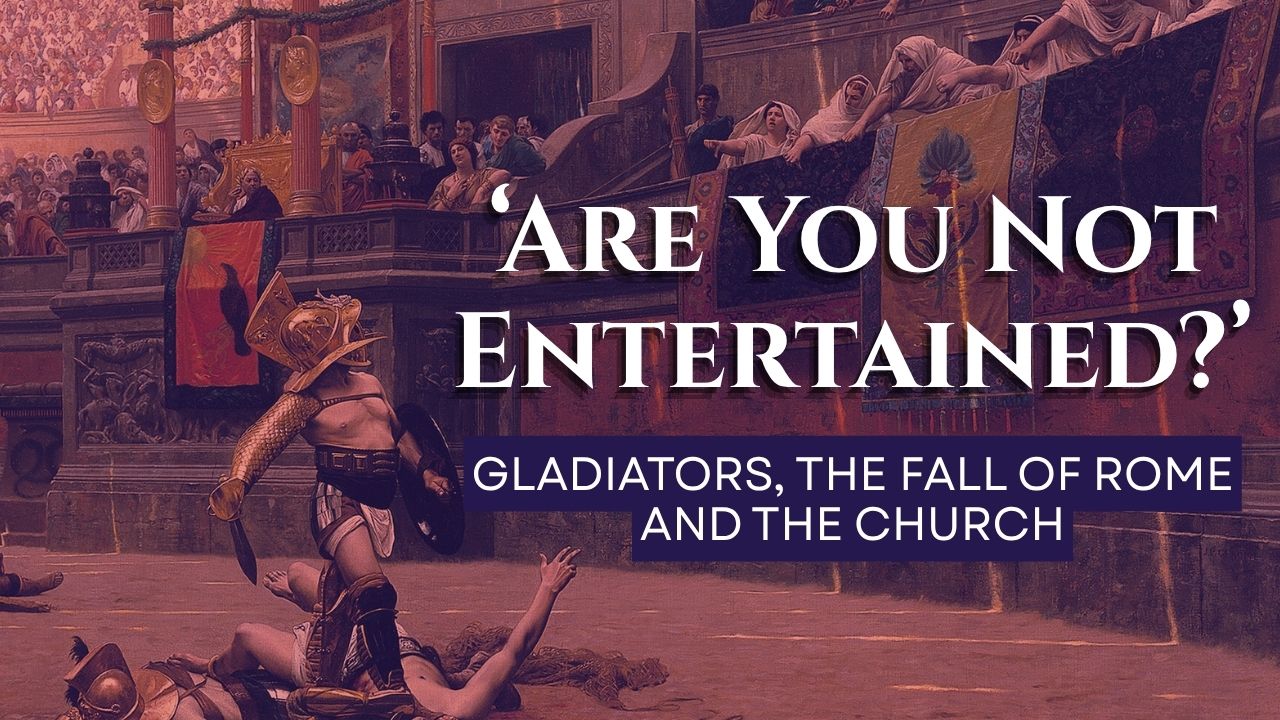
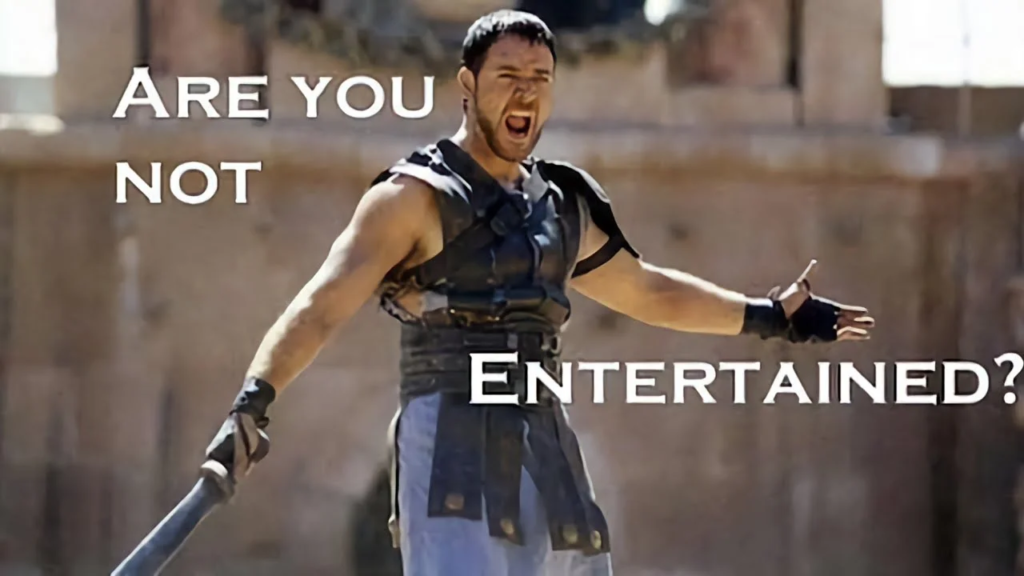
‘Are you not entertained?’ cries out Maximus Decimus Meridius in disgust as he kills man after man in gladiatorial combat (as played by Russell Crowe in Gladiator, 2000). His outburst silences the baying crowd for a moment, before they recommence their cheering. It’s a brutal, gruesome spectacle emblematic of a sick, self-indulgent Roman society that would eventually implode under the crushing weight of its own decadence. It was a society desensitised to violence and mindlessly enslaved to its own perverted pleasures.
Some ascetics at the time reacted against this wanton debauchery, but ultimately to no avail. Roman citizens took their prosperity and their civilisation for granted, which, in Edward Gibbon’s memorable phrase,
introduced a slow and secret poison into the vitals of the empire. The minds of men were gradually reduced to the same level, the fire of genius was extinguished, and even the military spirit evaporated.1
From producing great military leaders like Julius Caesar, Stoics like Cato, scholar-emperors like Marcus Aurelius or writers like Virgil, Rome ended up producing more hedonists than heroes, pleasure seekers instead of hard grafters. So Rome declined and fell; and in truth, despite its once lofty ideals and relative longevity, like all man-made empires it was always fatally compromised and destined for destruction.
I would argue that we live in a society that is not so different from Rome as we might like to think, the media may have changed, but the Western world is built around the same worship of self-gratification. What we entertain ourselves with is largely vapid and nonsensical, or worse, gratuitously explicit and violent. Either way, it’s escapism; we entertain ourselves to distract us from facing our problems. It’s convenient, easy and it gives us that dopamine hit that we so crave. Like the human beings in the 2008 robot film WALL-E, many of us sit in our chairs and stare at our screens all day every day, watching reel after reel, without a care for the world around us.

As the title of one book puts it, we are ‘Amusing Ourselves to Death’. In it, the author compares two dystopian visions of the future, George Orwell’s 1984 and Aldous Huxley’s Brave New World, and says that whereas the former ‘warns us that we will be overcome by externally imposed oppression,’ the latter points to something even more insidious but ‘equally chilling’—slavery to our own desires:
Orwell feared that the truth would be concealed from us. Huxley feared the truth would be drowned in a sea of irrelevance. Orwell feared we would become a captive culture. Huxley feared we would become a trivial culture, preoccupied with [our own pleasure].2
In Huxley’s book (which is an extremely disturbing vision of a male fantasy world that I would not recommend, by the way), people known as ‘alphas’ fill their time entertaining themselves at the expense of the lesser castes. They value human life cheaply and have sex with all and sundry. They drug themselves to be immunised from ever feeling any pain and to avoid all anxious thoughts. It’s intended as a hedonistic utopia but revealed to be a dehumanising prison of degradation from which there’s no escape but death.
The society that we are a part of has, like the Romans, largely numbed itself to graphic depictions of sex and violence. I think it says a lot about us that the TV shows which we lap up most are Love Island, Game of Thrones and Squid Game. Much of our music is either inanely feel-good or lyrically obscene. The three individually best-selling books of the last decade were the Fifty Shades of Grey trilogy. In the last couple of years, driven by social media trends, the most popular book genre among teenage girls is ‘romantasy’—romantic fantasy fiction, often with dark themes and a strong dose of sexual content.
If we become what we watch or are what we read, then what are we?
Shifting standards and some nuance
When cheap sensation novels (known variously as ‘penny dreadfuls’, ‘yellow-backs’ or ‘shilling shockers’) first cropped up in the Victorian era, there was an uproar. Many were scandalised. Prior to that point, most reading hadn’t so much been for entertainment purposes but for broadening the horizons of one’s mind. Now dramatic, captivating stories featuring murders, crime, romantic affairs and other ‘shocking’ subject matters in an easily consumable format took over the market.3
We might look back and laugh at how innocent our Victorian forebears were, but I think it shows how standards of what is socially acceptable have shifted. Our language has evolved too. The average sentence length in books has halved over the last couple of centuries. Now, some argue we’re fast becoming illiterate. Whilst I don’t agree with his every argument, one blogger traces this decline well (see The dawn of the post-literate society and the end of civilisation).
Right before our eyes, our façade of civilisation is crumbling; few vestiges of the era that produced our culture’s greatest works of art and literature are left. Our heroes are no longer great artists, philosophers, preachers or politicians, but reality TV stars and social media influencers. Whilst today we may have heroes from those other vocations, the products of a society that values soundbites over substance are not of the same calibre.

Call me nostalgic if you like, but there’s really no comparison between the political and literary debates of yesteryear and today. Whilst it was quite performative, consider one from the ‘Greatest Generation’ like war-hero and political bruiser Denis Healey who—in addition to a terrific pair of eyebrows—possessed his own intellectual ‘hinterland’ of art, philosophy and culture. Contrast him against those who fill the houses of parliament today. These kinds of backgrounds may not have made them more competent or morally better than our politicians today, but at least they were multi-dimensional and actually thought about things for themselves.
I’m sure you’ve seen that meme doing the rounds which says:
Hard times create strong men.
Strong men create good times.
Good times create weak men.
Weak men create hard times.
It’s simplistic but I think there’s an element of truth to it nonetheless.
In the last century, Christian moralists like Mary Whitehouse eventually lost the battle against the so-called ‘permissive society’. But interestingly, there is a little nuance here—it’s perhaps not all doom and gloom. In our own century, third-wave feminism and the #MeToo movement has seen some success in areas where the former campaigns failed. For example, whilst violent pornography viewed privately is on the rise, public media is now less likely to present casual sexism and the objectification of women without their consent.
It’s important to state that we’re shouldn’t try to get back to some version of the past that exists only in rose-tinted remembrances. Older isn’t necessarily better. Bygone eras had their own problems they were blind to—which are often quite obvious to successive generations.
Entertainment and the church
It’s easy to point the finger at society as a whole; most people can agree it’s a veritable Babylon of abominations. But we must also turn our gaze inwards and consider our own entertainment habits. Any respectability we might wear is only a thin veneer; make-up that comes off when it rains. We may not partake of the really explicit stuff but we are still shaped by the media we consume. What we choose to watch, listen to or read reveals what is inside our hearts. And I don’t think it’s great…
We all have in us what theologians term concupiscence or original sin, that inherent tendency towards sin and self-gratification that is in all human beings since the fall of man in Genesis 3. The reality is our flesh is weak and our hearts are hotbeds of iniquity.
We could blame the film directors, social media companies and content creators (and there is a place for that), but, in a market-driven world, the reality is the entertainment they or their algorithms serve up to us merely reflects us and our desires. Augustine was paraphrased as saying:
Deliver me, O Lord, from that evil man, myself.4

We must beware of the enemy within as well as without; we are always our own worst enemies, we just often lack the self-awareness to recognise that in ourselves.
When all we do, all we talk about is how to entertain ourselves, something is up. We’ve moved ever further away from the pure worship of the Creator God of the universe. For Christians, it’s so much easier after a church service to chat about last night’s football or ask what someone’s been watching on Netflix, rather than having real, honest conversations about how our relationship with Jesus is at the moment, or to talk about what we learnt from the sermon or what book of the Bible we’re currently reading. In short, we often engage in surface-level small talk.
I think it’s a crying shame that our first question to a brother or sister in Christ is often ‘what do you do?’ rather than ‘how did you become a Christian?’ As one pastor puts it, we learn,
cold demographic details about one another – married or single, number of kids, occupation, general location of residence, and perhaps a hobby – but we know little about the struggle of faith that is waged every day behind well-maintained personal boundaries.
We spend so much time entertaining ourselves in make-believe worlds that we are insulated from the real world and this stops us from having deeper fellowship with one another in Christ.
I find this most egregious when church becomes an entertainment product, not built around gospel truth but instead what we think will most entertain people. The band is put up on the stage; it’s a performance rather than a congregation singing their heart out to God. The pastor becomes a stand-up comedian. We see trashy TV shows and try to create our own Christian versions of them, funny maybe but infantile in the extreme.
Now these things may not be wrong in and of themselves, but ends don’t justify means. Even if God does use these things—although more accurately, I’d say, in spite of them—we should stop pretending this is what good looks like or that this is as spiritually edifying as it can get. It’s a classic case of applying our culture to the Bible and not the other way round.
I’d far rather a boring but faithful preacher than one who regales his hearers with silly stories even as they teeter on the brink of hell. Of course, this doesn’t mean humour or cultural references in sermons are wrong (we must be able to relate to other people!), but it mustn’t be all. I think the church’s obsession with entertaining people rather than just preaching the gospel shows up our informal, casual, worldly Christian culture for what it is:
For the time will come when people will not put up with sound doctrine. Instead, to suit their own desires, they will gather around them a great number of teachers to say what their itching ears want to hear.
2 Timothy 4:3
Church is about worshipping God ‘in the Spirit and in truth’ together (John 4:23); everything else flows out of that. We’ve just got to be ourselves, keep it simple, and tell them ‘the old, old story of Jesus and His love’.
Is entertainment bad then?
‘Alright, steady on, Josh. You need to lighten up a bit, mate’, you might think. ‘Aren’t we meant to be here to “glorify God and enjoy Him”? I bet you’re fun at parties. You’re making it sound like all entertainment is bad. Plus I’ve heard you like your football, so get off your high horse!’
Okay, you will have no doubt noted that I’ve been illustrating my points with various references to films and books. I don’t think the solution to our obsession with entertainment is to shut ourselves away from the world (though it may not hurt to have a breather every once in a while!).
And yes, I enjoy football, but I should always set sensible boundaries and keep my wits about me, so that the thrill of the ‘beautiful game’ doesn’t become all-consuming. If I ever have to choose between Jesus and football, I don’t want there to be any hesitation about it.
In Christ, we have true, joyous freedom. It’s His world, there for our enjoyment in Him. It’s not wrong to enjoy ourselves or to relax by watching a film of an evening. We are no longer under law but under grace. But that’s not a licence to act with impunity:
‘I have the right to do anything,’ you say – but not everything is beneficial. ‘I have the right to do anything’ – but not everything is constructive. No-one should seek their own good, but the good of others.
1 Corinthians 10:23-24 NIV
The love of Christ constrains us (1 Corinthians 5:14). We take up our cross and follow Jesus in the path of self-denial. We act according to God’s word and our conscience, and we use our own judgement. We mustn’t live as mindless automatons and so ‘accidentally’ re-enslave ourselves to sin. Neither should we sit proudly above any criticism. We need to work on this together and be open for others to hold us accountable. Because of Jesus, we know a better way (Philippians 4:18).
I do think a massive part of the solution lies in keeping things simple. If we can create a great work of art that will honour God, then do so. But for most of us, we need to evaluate how we spend our time. What proportion of our waking hours, of our thought life, do we give to God? What proportion do we allot for our entertainment? Do the maths, you might well be surprised. Do you pray more than you watch stuff? Are you intentional about spending quality time with people instead of screens?
So many of these things aren’t completely wrong in and of themselves, but if they take the place of God, then they become an idol and distract us from what is important in life. We need to desire to spend time with Him more than anything else, as one old hymn says:
Show me Thy face, one transient gleam of loveliness divine,
And I shall never think or dream of other love save Thine.
All lesser light will darken quite, all lower glories wane;
The beautiful of earth will scarce seem beautiful again.
You don’t want to get to the end of your life and realise that you’ve wasted it on mere trifles, when all along Jesus was standing there, hands outstretched to you, the one who is altogether lovely.
We know we cannot redeem society, but we can point people to a perfect King with a perfect kingdom that will last for all time; citizenship is free and comes with innumerable, eternal benefits, including that of freedom from ourselves; and everyone is welcome.
- Edward Gibbon, The Decline and Fall of the Roman Empire, vol. 1, chap. 2 (Wordsworth, 1998), 45. ↩︎
- Neil Postman, Amusing Ourselves to Death (Penguin, 1985), xix. ↩︎
- Iain Murray has an intriguing thesis on this point and argues in his book, The Undercover Revolution: How Fiction Changed Britain (Banner of Truth, 2009), that the change in reading habits in the late Victorian era (cheap fiction in place of works of a higher nature) helped lead to the near-collapse of Christianity and Christian values in Britain in the centuries that followed. Whilst it was undoubtedly a contributing factor, I think it’s more likely to be correlation than direct causation. ↩︎
- Thomas Brooks, Smooth Stones Taken from Ancient Brooks: Selections from the Writings of Thomas Brooks by C.H. Spurgeon (Banner of Truth, 2011), 14. ↩︎

