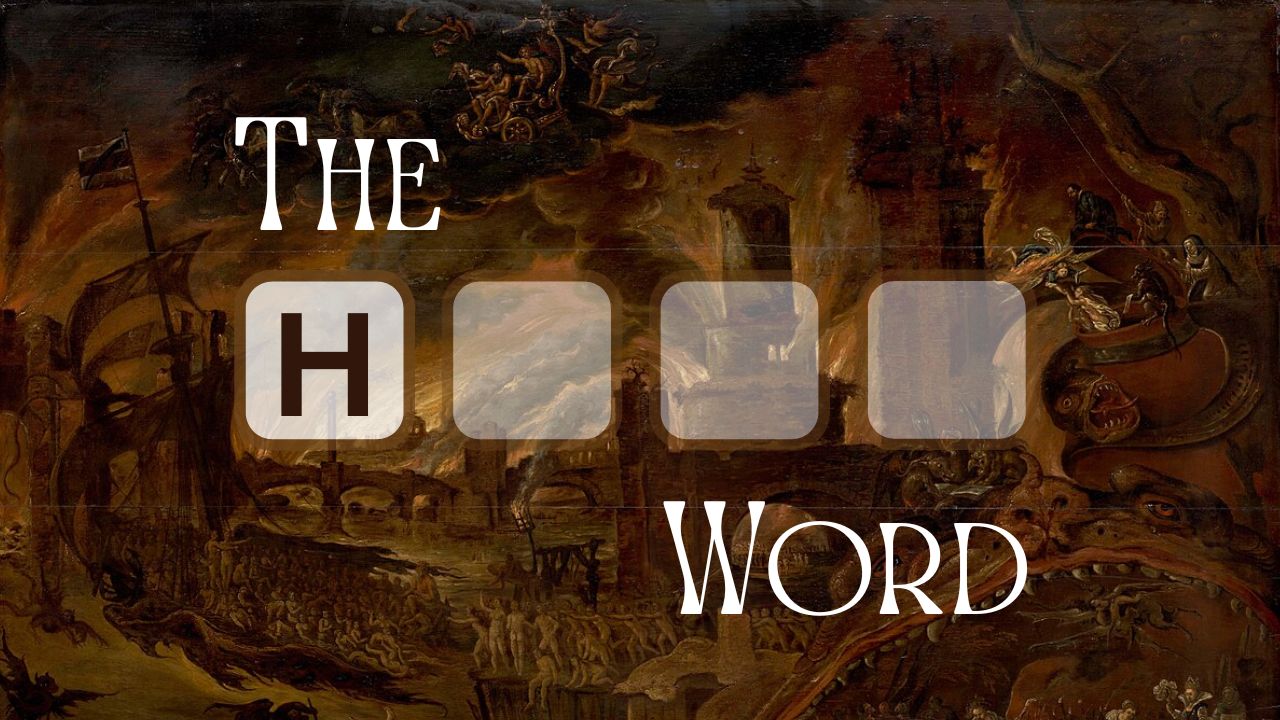
The H word
Hell. It’s probably the topic that Christians, myself included, least want to talk about, especially with our non-Christian friends. There is much in the Bible that shocks our morally relativist, pluralistic, liberal society, but the Bible’s teaching that, outside of Christ, all face an eternity in ‘the other place’ really takes the biscuit. More than feeling uncomfortable, it’s enough to send shivers down anyone’s spine. In one sense, this is understandable, you’d have to be a genuinely horrible person not to feel squeamish believing that any human being is destined for an eternity of unbearable suffering.
But is there a more needful topic in our day? Jesus spoke of hell more than any other person in the Bible. Hell is the Bible’s clear teaching throughout the Old and New Testaments (e.g., Daniel 12:2, Revelation 21:8). It’s not a scare tactic to give children and gullible people nightmares. It’s a stark reality. J. C. Ryle (1816-1900) writes,
there is a morbid tenderness amongst us which is not the tenderness of Christ. [The] watchman who keeps silent when he sees a fire is guilty of gross neglect, [and] the minister who keeps back hell from his people in his sermons is neither faithful nor [charitable].1
All of us will one day face judgement before God. ‘Those on his left [will] go away into eternal punishment, but the righteous [on his right] into eternal life’ (Matthew 25:41, 46).
In the late eighteenth-century, the preacher Jonathan Edwards’ fire-and-brimstone sermon, ‘Sinners in the hands of an angry God’ kick-started a mighty Gospel revival. Hell and sin when properly understood cause us to appreciate how amazing grace really is. Our society trivialises the idea of ‘the lake that burns with fire and sulphur’ (Revelation 21:8), just as it belittles sin and the notion of the devil. Cartoonish depictions of hell as the fiery domain of a little red, horned, mischievous devil wielding a pitchfork haven’t helped; think less Tom and Jerry, think more Tolkien’s Balrog dragging Gandalf down into a bottomless abyss.
The church needs to rediscover the doctrine of hell. Sin means hell; sin leads people to hell. It is a literal place, though not necessarily in the earthly sense. If people don’t understand what they need to be saved from and why they need a Saviour, why will they bother with the Gospel? If hell (as punishment for sin) isn’t real, then why on earth did Jesus, the everlasting Son of God Himself, have to suffer and die upon a cross?
Hell is not too harsh a penalty
Sometimes the world feels like such an unfair place, where evil and wicked people rule and oppress; but God’s justice and hell bring about ultimate fairness and true judgement (see Romans 2:1-11). Most of us accept that willingly enough for evil men like Hitler, Stalin and Pol Pot.
However, the Bible goes further. Even the slightest infraction against God’s standard of perfection is enough to warrant an eternity in hell. God’s word condemns all (Romans 3:23). God’s justice must be satisfied.
Yet to many of us hell seems harsh, extreme even. Would you lump the bloke who’s done one wrong thing in his life with all the evil dictators and mass-murderers? Is hell unfair…?
Imagine one day you’re walking along and you see a man on a park bench.2 He’s holding something small in his hands and plucking at it. Peering closer as you pass, you see he’s pulling the legs off of a grasshopper. That’s a bit weird and cruel, you think, but carry on your way.
Another time you see the same man on the bench pulling the legs off of a frog. There must be something wrong with this crazy guy. You might nudge a passer-by or phone the RSPCA.
The next day as you come along, you see him attempting to pull off the legs of a puppy… I think at this point you’d rush in and try and intervene to put a stop to this unnecessary cruelty.
But just imagine that the following day you see the man holding a baby… now who wouldn’t risk life and limb and do anything to save the child from this crazy man?
In each example, the action was the same. What changed was who or what the action was performed against. We care more about dogs than frogs, and rightly value human life over that of animals, especially grasshoppers.
So let me tell you, friends, that God is no grasshopper!
Sin, as one man put it, is cosmic high treason. When we sin against the infinite being, the punishment must be infinite. God is that infinite being. Infinite in His love but also infinite in His justice. His ‘eyes are too pure to look on evil’ (Habakkuk 1:13 NIV). God can neither deny Himself nor His justice.
Pelagianism has crept into the church again, which—to sum it up somewhat simplistically—means that human beings aren’t really that bad after all.3 We fail to consider the wicked depravity in our hearts, ‘that every inclination of the thoughts of the human heart [is] only evil all the time’ (Genesis 6:5 NIV).
God will judge each and everyone of us fairly. The Italian poet Dante’s nine circles of hell with Satan in the middle may well be fictional, but there will be degrees of punishment according to our sin and according to the opportunities God has given us to repent and turn in faith to Him through Jesus Christ.
Hell is not the absence of God’s presence
If God is everywhere by His Spirit, then what about hell? Some people think of hell as being the absence of God’s presence. In his classic book, The Existence and Attributes of God, the Puritan Stephen Charnock (1628-1680) instead explains that,
there are several manifestations of [God’s] presence; He has a presence of glory in heaven, whereby He comforts the saints [and] a presence of wrath in hell whereby he torments the damned.4
He goes on, echoing Psalm 139:7-12 (emphasis added):
In heaven He is a God spreading His beams of light; in hell, a God distributing His strokes of justice; by the one He fills heaven; by the other He fills hell. […] He is from the height of the heavens to the bottom of the deeps, in every point of the world, and in the whole circle of it, yet not limited by it, but beyond it […] [heaven] is the court of His majestical presence, but not the prison of His essence.5
Charnock states that God ‘is equally present with the damned and the blessed, as He is an infinite Being, but not in regard of His goodness and grace’.6 Charnock thus underlines the key distinction between hell and heaven. In hell, God’s mercy and grace is not present, but His righteous wrath and judgement is present. If hell is the absence of anything then it’s the absence of the mercy of God.
But some may wonder, how can hell be hell if God is present there? How can God send anyone to hell? Isn’t God all good and all loving? He is, and there’s much we could say here. Sunlight shines on all people, good and bad, righteous and unrighteous; this bears no reflection on the morality of the Sun itself. But in truth, we have things round the wrong way. The real question should be, if the Lord Jesus Christ is head over all things, why doesn’t God damn all to eternal hellfire for the willful rebellion against His precious Son we demonstrate every day? If we’re honest, we deserve no less… which leads us onto our final point and the reason God created hell.
Hell elevates God’s grace and justice
A preacher I heard once asked the question, ‘What words will never be heard in hell?’
Jesus’s words on the cross: ‘It is finished,’ (John 19:30).
For me this encapsulates so much about what we need to know about hell. It’s important to stress that Jesus the Son of God’s human body and soul did not enter into hell (‘today you will be with me in paradise’, Luke 23:43). Jesus didn’t go to hell, but He did experience hell—the full, unfiltered wrath and punishment of God on sin—on that cross. He suffered a million hells so that you and I might experience the joy of heaven. ‘He has done it’ (Psalm 22:31). The cross is where ‘wrath and mercy meet’.
For the Christian, the fear of hell has no hold on him or her. In Christ, we ‘who through fear of death were subject to lifelong slavery’ are delivered (Hebrews 2:15). Jesus holds ‘the keys of Death and Hades’ (Revelation 1:18) and His sweet, beautiful, free Grace is offered to all!
The Scottish theologian John Murray (1898-1975) writes:
The lost will eternally suffer in the satisfaction of justice. But they will never satisfy it. Christ satisfied justice […] He bore our iniquities. He bore the unrelieved and unmitigated damnation of sin, and He finished it.7
Murray goes on to explain why it must be this way:
It was in order that eternal and invincible love might find the full realization of its urge and purpose in redemption by price and by power. Of Calvary the spirit is eternal love and the basis eternal justice.8
Or as another theologian, Theodore Beza (1519-1605), put it, ‘we receive far more in Christ than we lost in Adam’.9 We receive the grace of God not just as our Lord but also as our Saviour.
The existence of hell ought to add a real, earnest fervency to our prayers. So many people we love and care for are teetering on the brink of eternal damnation blissfully ignorant of the mortal danger they are in. When we share the Gospel we must include this note of warning. Human beings are built with an innate fear of death and fear of judgement for a reason: because all of us desperately need to run to the Lord Jesus. When a house is burning down with people still inside, only a lunatic sits and watches. If we don’t warn people of their fate and tell them of the only Way out, who will?
These things are difficult to take. We human beings have fed ourselves so many misconceptions and misunderstandings. If you’re a Christian who struggles with the doctrine of hell; you’re not alone. If you’re not yet a Christian and would otherwise be drawn to Christianity were it not for uncomfortable doctrines such as hell; don’t feel like you can’t talk about it. Collectively, we need to come again once more to the Bible to see what it actually has to say about the matter, and then I hope we really can marvel at what Jesus has done for us!
- Ryle, Holiness: Its Nature, Hindrances, Difficulties, and Roots (Banner of Truth, 2014), 237. ↩︎
- I’m grateful to Erik Raymond, Is hell for real? (The Good Book Company, 2017) for where I first encountered this illustration, though I believe others have used it before. ↩︎
- Pelagianism follows the teachings of the British monk Pelagius. It denies the doctrine of original sin, imputed from Adam, and claims that human beings can achieve perfection by their own efforts. ↩︎
- Charnock, The Existence and Attributes of God, Vol. 1 (Baker Books, 1996), 370. ↩︎
- Ibid., 367, 370, 385. ↩︎
- Ibid., 373. ↩︎
- Murray, Redemption Accomplished and Applied (Banner of Truth, 2016), 72. ↩︎
- Ibid., 73. ↩︎
- Beza, ‘Supralapsarianism: The Fall of Man Was Both Necessary and Wonderful’ in Writings of Theodore Beza, available online at https://www.sermonindex.net/ebooks/w/writings-of-theodore-beza.pdf. Note that Beza advocates a view of the logical order to God’s decree that goes against the standard Reformed ‘infralapsarianism’. Personally I’m not so sure about either view! ↩︎
Further reading
- Romans 2:1-11 on God’s righteous judgement
- Erik Raymond, Is hell for real? (The Good Book Company, 2017).
- C. S. Lewis, The Great Divorce. Not a book to take literally, but as representative of certain aspects of hell, Lewis’s classic allegory is worth a read.
- John Murray, Redemption Accomplished and Applied (Banner of Truth, 2016). Seminal work on why Jesus had to die as the only way for our redemption.

