
Charles Spurgeon on suffering, depression and humour
For those uninitiated into the colourful world of one of the most gifted nineteenth-century preachers, you’re in for a treat! Charles Spurgeon (1834-92) was an enormously articulate, erudite, flowery pastor with a better sense of humour than most modern-day comedians. To top it all off though, he was a Spirit-filled vessel whom the Lord used mightily in an age where the church was descending (or ‘downgrading’) into ‘higher criticism’ and liberal theology.

However, one side to Spurgeon which doesn’t get too much attention is the very real struggle he had with depression throughout his own life. A while back I picked up a little book called Spurgeon’s Sorrows by Zack Eswine (144pp, Christian Focus, 2014). This post is partly a review of this book and partly my own gleanings from Spurgeon.
In his book Eswine seeks to provide some ‘realistic hope for those who suffer from depression’ or those caring for such, based on Spurgeon’s life and ministry. His is an excellent, heartfelt message of just that—realistic hope. Not brushing over the issue, not wasting your time with dull platitudes, but approaching the topic cognisant of the mental pain and suffering that many Christians endure.
I’ve read a few books on mental illness and depression (see my recommendations below), and, I’ll be honest, I came into this one a bit wary despite the rave reviews. Making a book—any book—all about the writings of one man rings alarm bells; too often this can end up in hero worship where we make that person out to be something that only one Person ever was. However, this fear was straightaway allayed by Eswine’s determination to call Spurgeon, the so-called ‘Prince of Preachers’, by his first name throughout—‘Charles’! This served to get my attention anyway and I’m sure helps make this book and Spurgeon’s own struggles less distant and that bit more relatable. And old Chazza certainly has much wisdom to impart on the subject of suffering, yet with a cheery light-hearted tone belying his own dark experiences of affliction. In this post, I’ve similarly taken a lighter tone in places, despite some of these topics being heavy ones, so I hope you’ll bear with me.
Spurgeon: relevant for today?
Zack Eswine has written previously on Spurgeon and evidently has a very good working knowledge of our guy’s wide oeuvre (or a pretty nifty search engine!). In his book, he takes on this difficult topic by splitting the little book into three parts: understanding depression, helping those with depression, and some practical helps. Whilst this structure and the chapters within are all his own, Eswine illustrates his every point with choice quotations on mental health, anxiety and depression from his mate Charles. And, man, was Spurgeon ahead of the game for a bearded, chain-smoking Victorian dude! He has none of the reserve, stiff upper lip, prudishness and humourlessness we sometimes associate with the Victorians. He was a product of his time, for sure, but his views on a lot of things are way more in-tune with our precious ‘twenty-first century values’. If I gave a sample of his writings, you might be forgiven for thinking he was:
an ecumenical,
In Brussels, I heard a good sermon in a Romish church. The place was crowded with people, many of them standing, though they might have had a seat for a halfpenny or a farthing; and I stood, too; and the good priest — for I believe he is a good man, — preached the Lord Jesus with all his might.
C.H. Spurgeon Autobiography, Volume 2: The Full Harvest 1860-1892 (The Banner of Truth Trust, 1973), pp.21-22
a proto-feminist,
[We saw] poor women compelled to work like slaves, as if they were only made to support their husbands in idleness. They were lagged and worn; but they looked more fully developed than the men, and seemed to be more masculine. If I had been one of those women, and I had got a little bit of a husband sitting there smoking his pipe, if there is a law in Belgium that gives a woman two months for beating her husband, I fear I should have earned the penalty […]
Autobiography, Vol.2, p.23
The fact is, my dear friends, to come to something that may be worth our thinking about, employment for women is greatly needed in our country, and the want of it is a very great evil.
or even an animal rights activist,
Every other means which would come under the head of example or precept, reward or punishment, should be continually employed; and no exertion should be spared till cruelty to animals shall be an unknown vice, or at least shall be universally regarded as the distinguishing mark of the lowest and basest of the people.
A Word for Brutes Against Brutes
[…]
A holy mind sympathises with Cowper in his refusal to enter on his list of friends the man “who needlessly sets foot upon a worm,” and fully agrees with Dr. Blair that it is “shameful to treat even the meanest insect with wanton cruelty.”
Of course, the discerning Christian reader ought not to jump to conclusions but consider the nuances of what Spurgeon says in its original context. We often look on the past and people from the past as backwards—because we’re all on an ever-advancing quest for heavenly perfection here on earth, right?! The fact is, ladies and gents, our forebears were made in the image of God—just like us—with divine sensibilities stamped on their consciences. They too were muddlers muddling their way through life—just like us—whether our or their zeitgeist like(d) it or not. Sure, every generation has its blind spots (which is what makes history such a fascinating pursuit!). But it shouldn’t surprise you to learn that mental illness and mental suffering is nothing new. Whilst today we have the benefit of modern neuroscience and psychology, humans have been dealing with suffering and mental health problems since time immemorial.
Spurgeon: nineteenth-century comedian
Charles is renowned as a larger-than-life character in every sense of the phrase. Like Martin Luther, another jolly, rotund preacher who was also prone to bouts of depression, Spurgeon found that ‘a light heart can bear heavy burdens’ (Salt Cellars). He liked a good joke as much as anyone, and even the pulpit sometimes wasn’t off-limits. See, for example, his John Ploughman persona, or his wisecracks about elephants in Elephant and Castle, where the Metropolitan Tabernacle (‘Met Tab’ for short), his church, was based. Perhaps this was a way for him to cope with his struggles, or perhaps this was just his character shining through and he couldn’t help himself. Let me give you an example:
[Spurgeon greeted a lesser-known acquaintance:] “Glad to see you, Mr. Partridge.” The visitor was surprised to find himself recognised, but he replied, “My name is Patridge, sir, not Partridge.”
Autobiography, Vol. 2, p.439
“Ah, yes!” was the instant rejoinder; “I won’t make game of you any more.”
If that causes you to groan, then Spurgeon made far worse puns, including one about Lot causing a whole ‘lot’ of trouble to his uncle, Abraham.
If you had known how many others I kept back, you would not have found fault with that one, but you would have commended me for the restraint I had exercised.
Autobiography Vol.2, p.440
Spurgeon demonstrates that humour, when used wisely, can be a real tonic in times of trial. There is a ‘time to weep and a time to laugh’ (Ecclesiastes 3:4), and a ‘joyful heart is good medicine’ (Proverbs 17:22). Or, to change the metaphor:
There are difficulties in everything except in eating pancakes.
John Ploughman’s Pictures
Spurgeon: a living theology of suffering
Much of Spurgeon’s own experience of depression stems from his prolonged mental anguish after a horrific accident early on in his preaching career. A prankster yelled ‘fire’ at a service packed with many thousands of people: this caused mass panic and a stampede in which seven people were killed. Spurgeon blamed himself for the event and struggled with the trauma of it for the rest of his life. Even twenty-five years afterwards, there was one particularly bad flashback just before he was due to preach, which effectively paralysed him for a time, before he recovered and managed to continue. Even the best of men are men at best; they’re human too, which is something people often seem to conveniently gloss over when they’re flinging mud at leaders and politicians—including the church as well: Joel Beeke states that 85% of ministers who quit the pulpit do so because of criticism of their ministry.
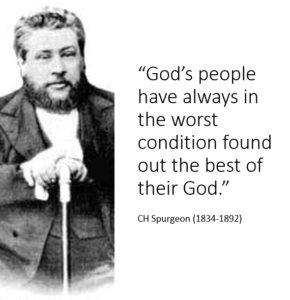
Spurgeon was also someone who experienced much physical discomfort in his life, probably exacerbated by the fact that he worked himself into the ground to keep up all his various ministries. He suffered from poor health all his life, and gout in particular. In one biography of Spurgeon, his life is described as a ‘living theology of suffering’. When you read his writings, you can’t help but notice there’s a depth and pathos that can really only have come from such a life of suffering.
In reading Eswine’s book, chock-full of quotes from Charles, I was struck by the rawness of emotion that the preacher freely gave way to. To take one example, a letter to a friend asking for him to step in to preach in Spurgeon’s place, ‘because I feel low and weak’. And it wasn’t just in private correspondence that he shared such feelings either: from the pulpit he would be honest concerning his own emotions, providing the same encouragement to his congregation to give voice to their own sufferings. Charles would point to people in history such as William Cowper, Martin Luther, David or Elijah and declare that ‘You are not the first child of God who has been depressed or troubled … Do not, therefore, think that you are quite alone in your sorrow’.
Eswine’s book is useful as an introduction to the man, but you really are best off reading him directly yourself. Spurgeon recognised that the source of mental suffering is not always spiritual and that, where it stems from a ‘physical disorder’, it ‘is rather the business of the physician than of the divine’, requiring great patience, care and love.
It is a real disease, it is not imaginary. Imagination, no doubt, contributes to it, and increases it; but, still, there is a reality about it. There are some forms of physical disorder in which a person lying in bed feels great pain through another person simply walking across the room. “Oh!” you say, “that is mere imagination.” Well, you may think so, if you like; but if you are ever in that painful condition, — as I have been many a time, — I will warrant that you will not talk in that fashion again. “But we cannot take notice of such fancies,” says one. I suppose that you would like to run a steam-roller across the room, just for the sake of strengthening their nerves! But if you had the spirit of Christ, you would want to walk across the room as though your feet were flakes of snow; you would not wish to cause the poor sufferer any additional pain. I beg you, never grieve those upon whom the hand of God is lying in the form of depression of spirit, but be very tender and gentle with them.
‘The Cause and Cure of a Wounded Spirit’, sermon on Proverbs 18:14
Sometimes it can be difficult to know why someone feels down in the dumps—the chemical, emotional and spiritual are often indiscernibly intermingled. As Alan Thomas writes in his book, Tackling Mental Illness Together, we are ‘psychosomatic wholes’. Spurgeon, of course, recognised the spiritual element in these matters, which can often be the devil’s hand. In such cases, his counsel was clear:
The devil has been arguing with Christians for so many years, that he understands the case against them a great deal better than any of us do, and if we begin to controvert with him, we shall soon find that that old hater of man will soon get the mastery over us. But if we say, “I give it in, Satan—I give it in, I am a sinner—the chief of sinners, hast thou anything more to say? I give it all in, but I answer thee with this—‘The blood of Jesus Christ, His Son, cleanseth us from all sin, I believe in Him, and my sins are, therefore, washed away,’”—this is the high road to perfect comfort.
‘A Call to the Depressed’, sermon on Isaiah 52:2
The Christian life is not an easy one, Spurgeon knew that more than most. The devil and his minions hound us all the way to glory; we live in fallen, broken bodies and minds in a fallen world; but our eternal destiny is sure, our sin is paid for and Christ will hold us fast!
Jesus: Man of Sorrows, Saviour
Charles Spurgeon lived to point people, not towards himself, but towards the Lord Jesus.
Accompanying his aforementioned sermon on Isaiah 52:2, are some of Spurgeon’s notes on Romans 8. Verse 28, in particular, is familiar, I’m sure:
And we know that all things work together for good to them that love God, to them who are the called according to his purpose.
Romans 8:28 KJV
This verse is frequently taken out of context, it must be said, but this is not what Spurgeon does. Instead, he writes out that verse in its context (Romans 8:28-39) to give us the grounding in scriptural truth that suffering and depression can sometimes cause us to lose.
This passage contains many verses of great encouragement for the downcast, but the key on which this passage turns is verse 32:
He that spared not his own Son, but delivered him up for us all, how shall he not with him also freely give us all things?
Romans 8:32 KJV
Jesus Christ is the Man of Sorrows. No one suffered mental, spiritual, emotional anguish like Him. Jesus is more than able to empathise and care for those who feel like emotional wrecks. He knows what it is to be attacked by the devil in his weakest moments. Jesus has been there. He knows the ‘Slough of Despond’ (as John Bunyan called it in Pilgrim’s Progress) better than anyone. More than any, He knows what it is to feel the guilt of sin (not His own), and He knows what it is to feel that infinite weight lifted after it has been fully atoned for. If God did not spare His own Son to suffer and die for our sake, then surely it’s not too much to expect that He won’t also carry us all the way safely home to be with Him forever?
Spurgeon took another metaphor from Pilgrim’s Progress, that of the ‘River of Death’; I’ll let Eswine tell it:
Charles cherished a certain picture. The engraver portrayed the moment in Pilgrim’s Progress in which Christian panics, swallowed up by the deeps of a river and going under. The portrait shows Christian’s companion, named Hopeful, pushing up with his arm around Christian and lifting up his hands shouting, “Fear not! Brother, I feel the bottom.”
With this picture in mind, the preacher so familiar with sorrows then rejoices with those listening to him. “This is just what Jesus does in our trials,” Charles proclaims. “He puts his arm around us, points up and says ‘Fear not! The water may be deep but the bottom is good.’”
Christian brothers and sisters, know that Jesus has been right to the bottom for us. Yes, this life brings suffering. We may succumb to illnesses or temptations, but ‘Jesus Christ is the same yesterday [and in Spurgeon’s day, we might add] and today and forever’ (Hebrews 13:8)! Spurgeon now enjoys rest and glory inexpressible with his Saviour, and, like him, we too can trust we will one day cross from death to life on the body of Christ Jesus which bridges that great once-uncrossable chasm. We need not fear the slough nor the river. God our Father is good, ‘and underneath are the everlasting arms’ (Deuteronomy 33:27 KJV).
All that remains now is for us to say with Paul, Charles and many other saints throughout history:
Who shall separate us from the love of Christ? shall tribulation, or distress, or persecution, or famine, or nakedness, or peril, or sword? […] Nay, in all these things we are more than conquerors through him that loved us. For I am persuaded, that neither death, nor life, nor angels, nor principalities, nor powers, nor things present, nor things to come, nor height, nor depth, nor any other creature, shall be able to separate us from the love of God, which is in Christ Jesus our Lord.
Romans 8:35, 37-39 KJV
‘Hallelujah! Blessed be His name.’
Further reading
- Any sermons by Spurgeon you can get your hands on. Of particular interest are:
- For examples of Spurgeon’s humour, see the chapter ‘Pure fun’ in volume 2 of his autobiography (Banner edition; in the original it’s volume 3)
- Pilgrim’s Progress by John Bunyan, especially where Christian encounters the Slough of Despond, Doubting Castle and Giant Despair. Bunyan has given us much vocabulary and imagery for our own life’s journey, we could do worse than make use of it!
- The Psalms, especially 22, 51, 73, 88 and 130
- Dealing with doubts
- When God doesn’t answer our prayers
- Some modern books I recommend on depression:
- Christians Get Depressed Too by David Murray
- Tackling Mental Illness Together by Alan Thomas
- Spiritual Depression by Martyn Lloyd-Jones
- Wrestling With My Thoughts by Sharon Hastings
- Side by Side: Walking with Others in Wisdom and Love by Edward Welch

